Software engineering
Services Provider Application — ASP.NET Core Home Services Platform
An ASP.NET Core MVC platform that connects customers with trusted home-service providers, enabling service discovery, provider profiles, booking, and appointment management.
- Evidence
- Verified work
- Role
- full project
- Category
- Software engineering
- Technologies
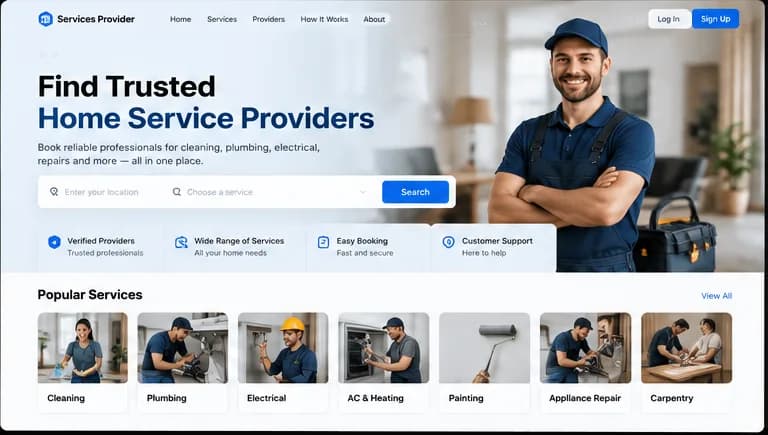
Overview
The Services Provider Application is an ASP.NET Core MVC web platform designed to connect customers with professionals who provide home services.
The platform creates a structured marketplace experience where customers can discover services, browse providers, review their profiles, compare offerings, and request appointments.
On the provider side, the system provides the foundation for managing services, bookings, customer relationships, and availability.
The goal is to bring both sides of the service marketplace into one coherent digital platform.
Problem
Finding a reliable professional for a home service can often involve searching through multiple sources, contacting providers individually, comparing prices manually, and coordinating appointments through phone calls or messages.
This creates several problems:
- Difficult provider discovery
- Limited service comparison
- Unclear provider availability
- Fragmented communication
- Manual appointment coordination
- Limited visibility into provider reputation
- Poor organization of previous bookings
The platform addresses these issues by creating a centralized environment where customers can discover providers, understand their services, and manage bookings through a structured workflow.
Constraints
The project was designed as an ASP.NET Core MVC service marketplace, with the primary focus on the core customer-provider relationship rather than attempting to reproduce every feature of a large commercial marketplace.
Key constraints included:
- Keeping the booking experience straightforward
- Supporting both customers and providers
- Organizing multiple service categories
- Providing useful provider discovery
- Maintaining clear booking states
- Keeping the MVC architecture maintainable
- Avoiding unnecessary marketplace complexity
- Creating a foundation that can support future expansion
The objective was to establish the core mechanics of a service marketplace while keeping the application understandable and extensible.
Approach
The platform was designed around the complete customer journey:
Discover → Search → Compare → Review Provider → Book Service → Manage Appointment
Customers can search for a specific service, filter available providers, inspect professional profiles, review offered services and ratings, and proceed through a structured booking process.
The platform also considers the provider side of the marketplace, allowing service professionals to manage their offerings and customer appointments.
The main experience is organized around:
Services → Providers → Profiles → Booking → Customer Dashboard
This approach creates a marketplace where discovery and booking are connected instead of requiring customers to coordinate every step manually.
Architecture
The platform follows a conventional layered ASP.NET Core MVC architecture:
Browser → MVC Controllers → Application / Business Logic → Data Access → Database
Presentation Layer
The MVC views provide the customer and provider interfaces, including:
- Home page
- Service catalog
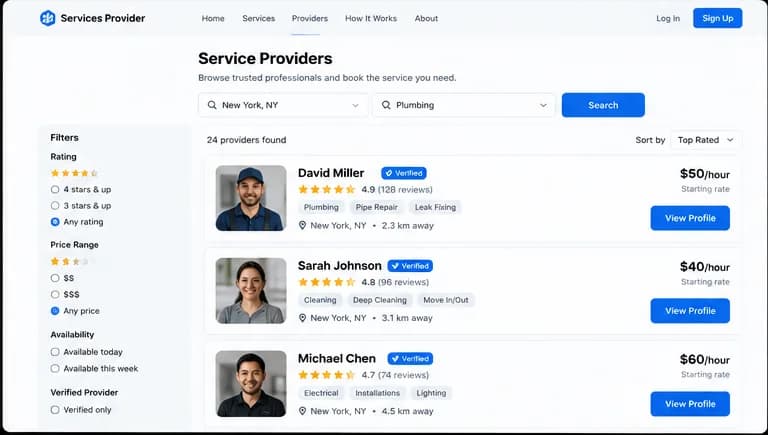
- Provider search
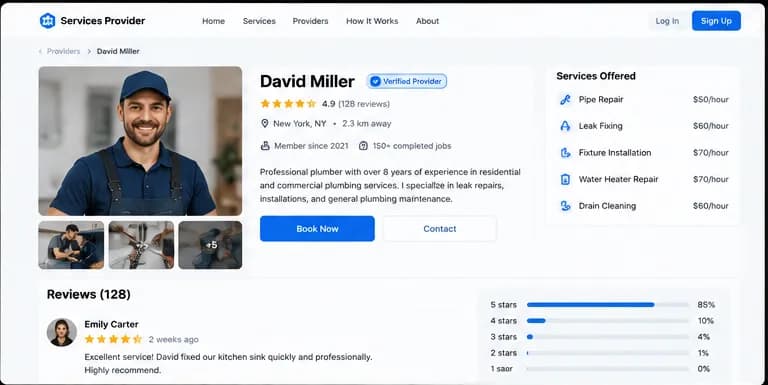
- Provider profiles
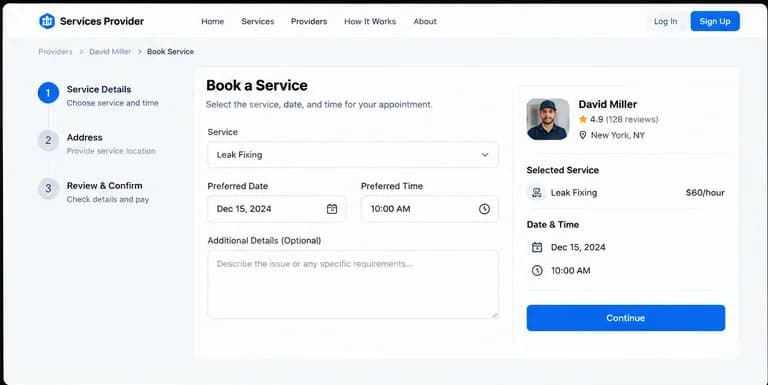
- Booking forms
- Customer dashboard
- Appointment management
MVC Controllers
Controllers coordinate incoming requests, validate the required information, invoke application logic, and return the appropriate views or responses.
Application / Business Layer
Business logic handles core marketplace rules such as:
- Provider discovery
- Service selection
- Booking creation
- Booking status transitions
- Availability rules
- Pricing calculations
- Customer-provider relationships
Data Access Layer
The data layer persists the core marketplace entities and their relationships.
Typical entities include:
- Users
- Customers
- Providers
- Services
- Provider Services
- Bookings
- Reviews
- Addresses
- Availability
- Payments
Database
The relational database provides persistent storage for users, services, provider profiles, appointments, and marketplace activity.
Intelligence layer
The platform's intelligence is primarily rule-based and data-driven, rather than dependent on machine learning.
Provider Matching
Search results can be filtered and organized using attributes such as:
- Service category
- Location
- Rating
- Price
- Availability
- Verification status
Availability Logic
Provider availability can be evaluated against requested dates and times before a booking is confirmed.
Booking State Management
Business rules determine which transitions are valid during the appointment lifecycle.
Provider Ranking
Providers can be presented according to relevant marketplace signals such as ratings, reviews, verification, availability, or customer-selected sorting preferences.
Service Recommendations
The platform can use customer searches and selected service categories as a foundation for suggesting relevant providers or related services.
This provides a practical intelligence layer while keeping the underlying behavior transparent and deterministic.
Engineering decisions
ASP.NET Core MVC
MVC was selected as the application architecture because it provides a clear separation between presentation, request handling, and application logic while fitting the server-rendered marketplace workflow.
Layered Architecture
Separating presentation, business logic, and data access reduces coupling and makes individual areas easier to maintain.
Domain-Oriented Entities
Customers, providers, services, and bookings are modeled as distinct concepts because each represents a different responsibility within the marketplace.
Explicit Booking Lifecycle
Booking status is treated as an explicit domain concern rather than simply a boolean value. This makes appointment workflows easier to reason about and extend.
Provider Profiles
Provider profiles centralize professional information, services, ratings, experience, and availability, giving customers the information needed before booking.
Search and Filtering
The discovery experience is designed around meaningful marketplace attributes instead of forcing customers to browse providers manually.
Reusable Service Model
Services are represented independently from providers, allowing the same service category to be offered by multiple professionals.
Extensible Architecture
The platform can later support features such as online payments, notifications, messaging, provider verification, geolocation, advanced scheduling, customer reviews, and recommendation systems without fundamentally changing the marketplace model.
Challenges
1. Connecting Two Sides of a Marketplace
The platform serves both customers and service providers, each with different requirements, workflows, and information needs.
2. Provider Discovery
Customers need to find relevant professionals quickly. Search, service categories, location, ratings, availability, and pricing all influence provider discovery.
3. Building Trust
Home services require a certain level of confidence before a customer allows a professional into their home. Provider profiles, verification indicators, ratings, reviews, experience, and completed jobs therefore become important parts of the experience.
4. Appointment Booking
Booking requires more than selecting a provider. The system needs to capture the service, preferred date, preferred time, address, and additional customer requirements.
5. Managing Booking States
Appointments naturally move through different stages:
Requested → Confirmed → Scheduled → Completed / Cancelled
Maintaining these states consistently is important for both customers and providers.
6. Search and Filtering
A service marketplace can contain many professionals. Users need meaningful filters such as service type, rating, price range, availability, and location.
7. Maintaining a Consistent MVC Structure
Because the platform is built with ASP.NET Core MVC, maintaining a clean separation between controllers, views, models, business logic, and data access is important as the number of features grows.
Results
The project establishes a functional foundation for an ASP.NET Core home-services marketplace connecting customers with service professionals.
The platform covers the core journey from:
Service Discovery → Provider Selection → Profile Review → Booking → Appointment Management
It demonstrates practical concepts in:
- ASP.NET Core MVC
- Marketplace architecture
- Relational data modeling
- Service discovery
- Provider management
- Booking workflows
- Search and filtering
- Business-rule implementation
- Customer-provider interaction
The architecture also provides a foundation for evolving the application into a more comprehensive home-services marketplace with payments, messaging, notifications, location services, provider verification, advanced scheduling, and intelligent provider recommendations.
Media

Related projects
Software engineering
Tavola — Multi-Tenant Restaurant Reservation Platform
A multi-tenant SaaS for restaurant reservations, tables, branches and staff: NestJS backend with real-time updates, a Flutter customer app, a React restaurant dashboard and a platform-owner console.
Stack
Software engineering
Dr. Elias Dahdal Clinic — Clinic Management System
A multi-department clinic management system in production: reception, laser, dermatology and dental workflows, billing and accounting in two currencies, payroll, inventory, audit and a patient portal.
Stack

Software engineering
VegaCore Operating System (VOS)
An ERP / CRM / project-management platform for VegaCORE: CRM, projects, marketing, media, HR, finance, archive and AI modules on NestJS, Prisma, PostgreSQL and Next.js 15.
Stack