Artificial intelligence
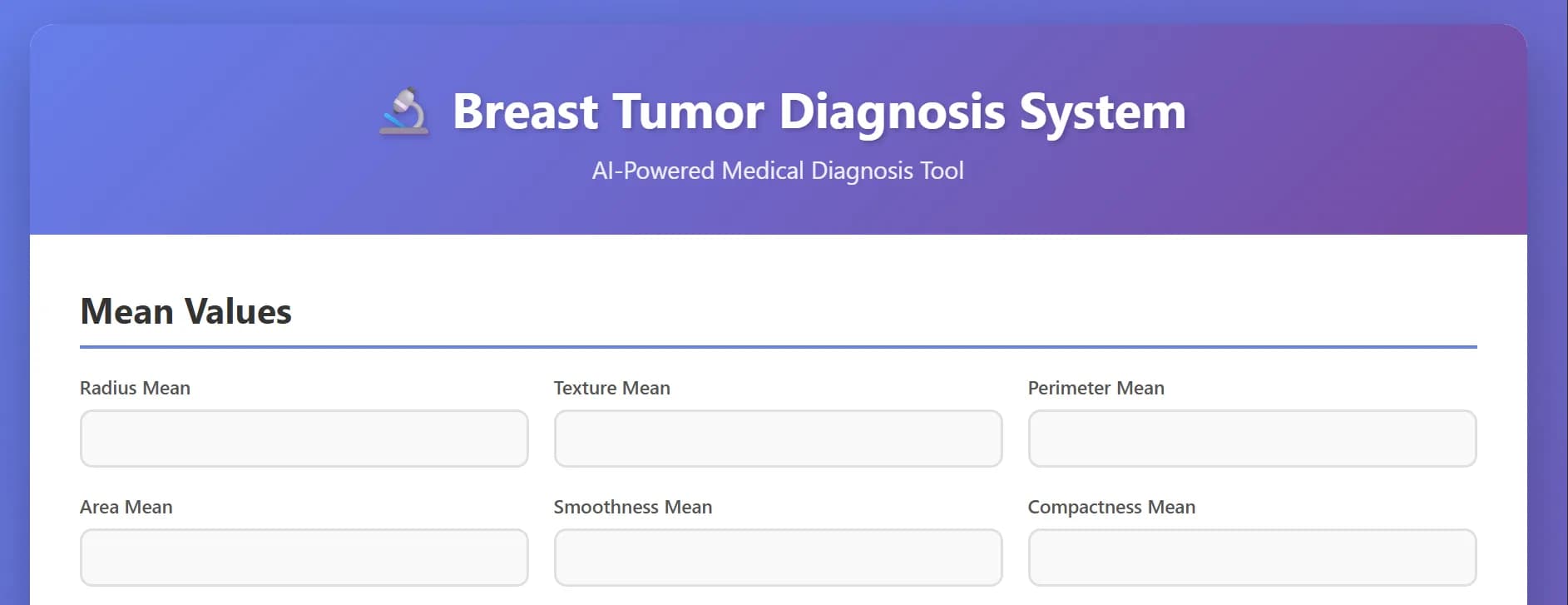
Breast Tumor Diagnosis System
A K-nearest-neighbours classifier that labels a breast tumour benign or malignant from 30 diagnostic features, served through a Flask REST API with a web interface.
- Evidence
- Verified work
- Category
- Artificial intelligence
Overview
A machine-learning web application that classifies a breast tumour as benign or malignant from 30 diagnostic features, with a web interface for clinicians' inputs and a REST API for integration.
Problem
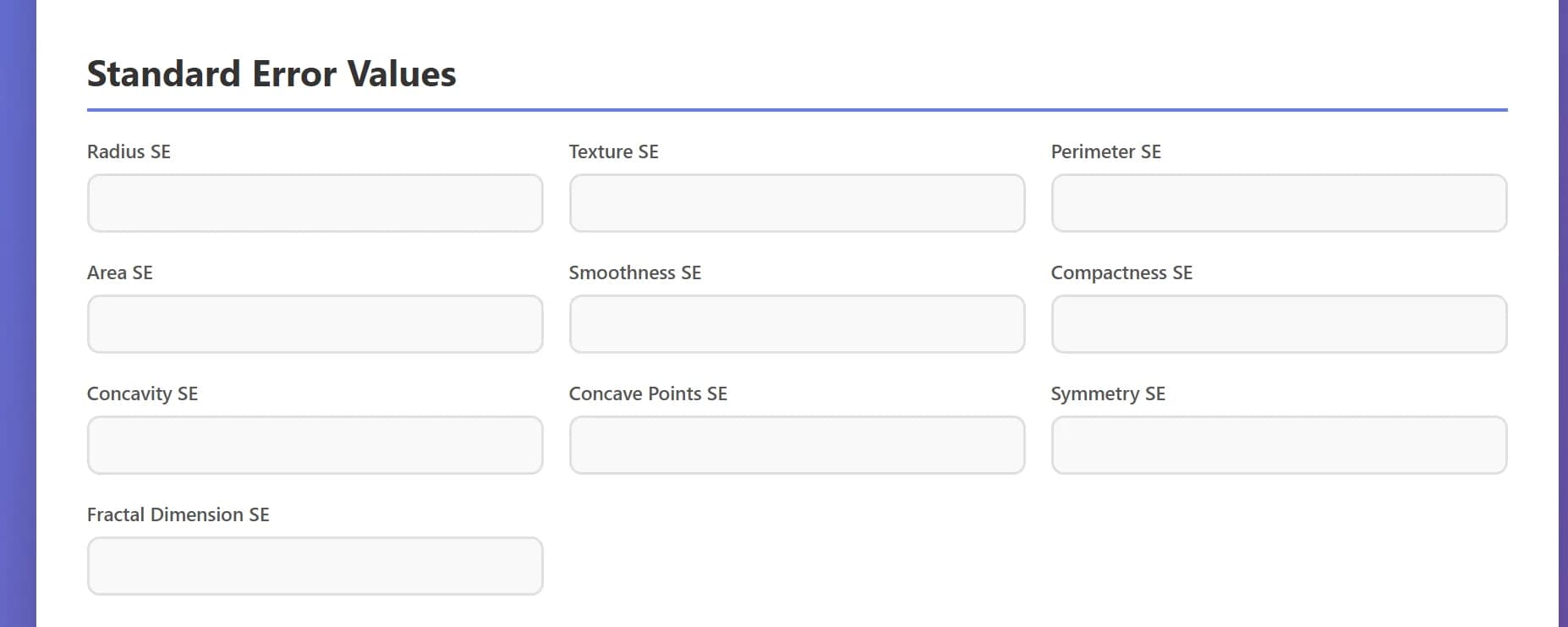
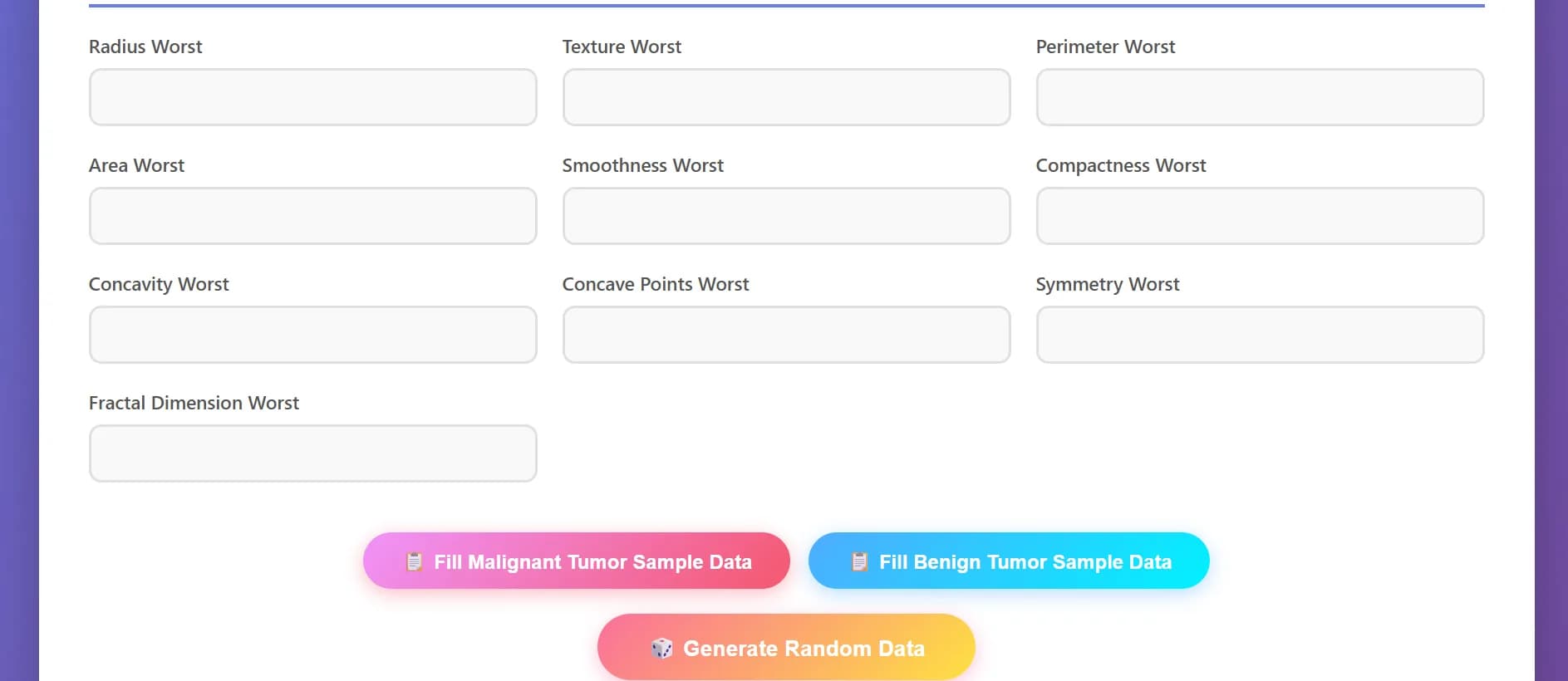
Diagnostic features extracted from tumour images — radius, texture, perimeter, area, smoothness, compactness, concavity, concave points, symmetry and fractal dimension, each as a mean, a standard error and a worst value — need to be turned into a transparent benign/malignant prediction with a probability for each class, not a bare label.
Architecture
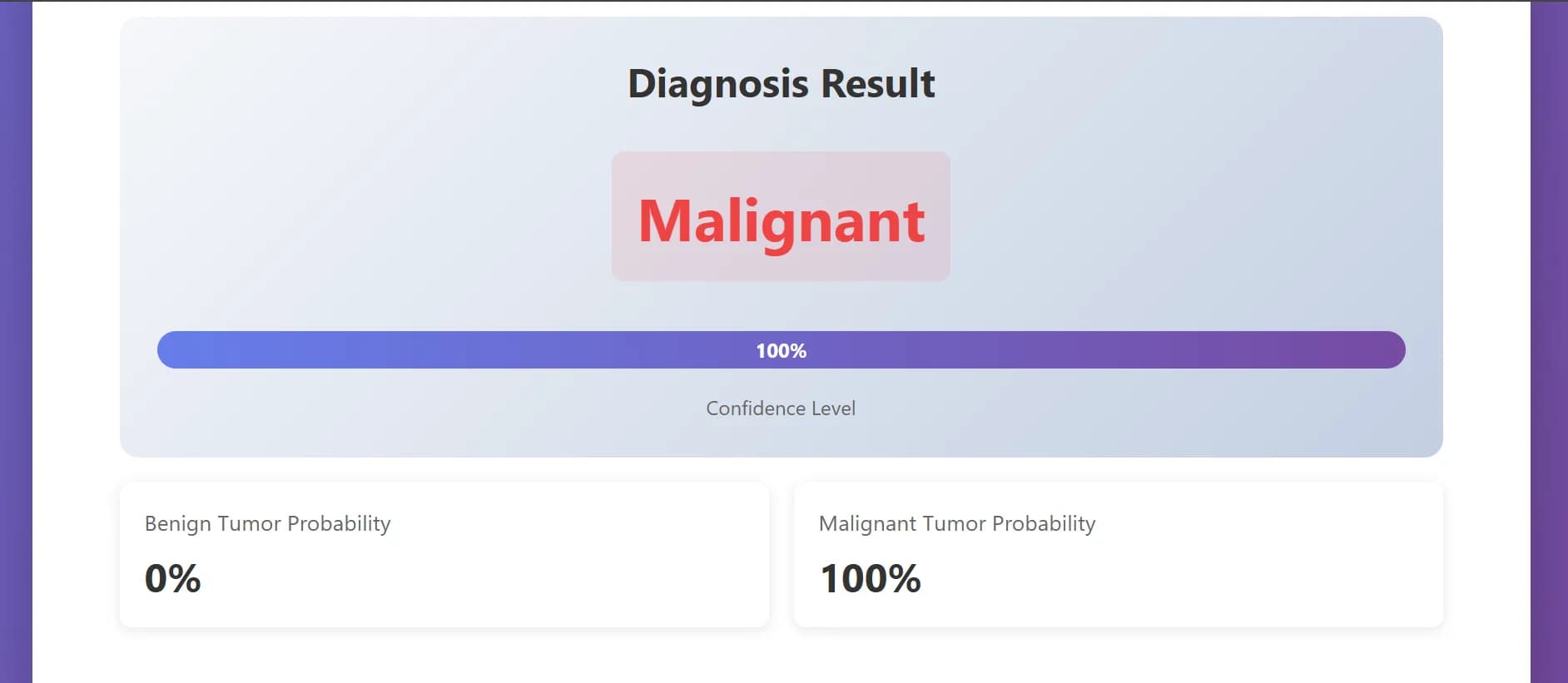
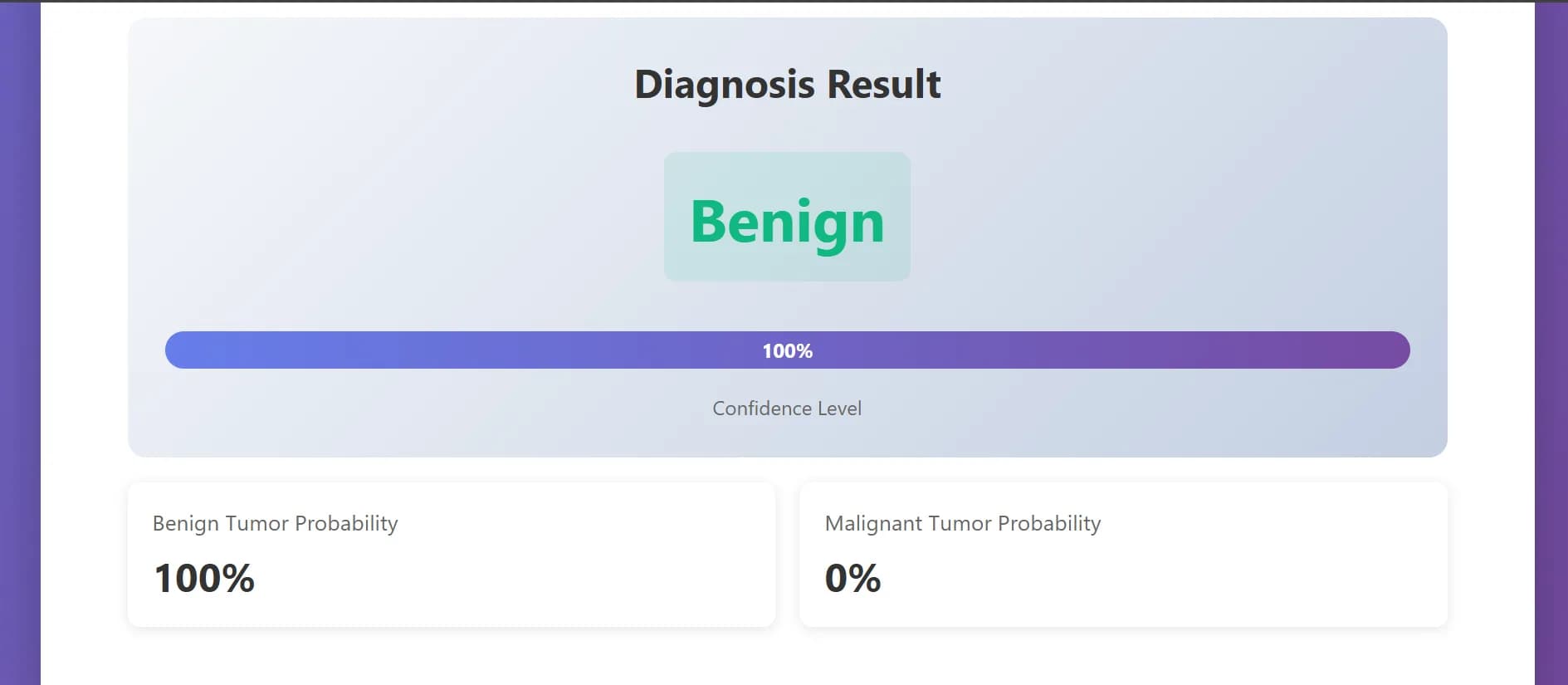
A Flask API loads the serialised model and scaler at start-up and exposes GET /health (model and scaler status) and POST /predict, which validates all 30 features and returns the class, a confidence value and both class probabilities. The web interface is plain HTML, CSS and JavaScript with benign, malignant and random sample inputs for testing.
Intelligence layer
The model is a K-nearest-neighbours classifier selected by hyper-parameter search (k = 3, uniform weights, Manhattan distance), trained on the Breast Cancer Wisconsin (Diagnostic) data set — 569 samples, 30 features, 357 benign and 212 malignant. Inputs are standardised with the same scaler used in training before inference.
Results
As reported in the repository for the held-out test set: 96.49 % accuracy, 91.67 % precision, 97.06 % recall, 94.29 % F1 and 98.97 % ROC-AUC (98.02 % training accuracy). These are offline evaluation figures on a public research data set — not clinical validation.
Media
Related projects
Artificial intelligence
Trading AI Assistance — Backend Architecture
The backend architecture of a trading-analysis platform: market-data ingestion, strategy execution, explainable AI signals, a model registry and leakage-safe backtesting, as a modular monolith with a Python inference service.
Stack
Artificial intelligence
AI Intelligence Project Management System
AI-powered enterprise project and task management platform with intelligent task generation and smart assignment.
Stack

Robotics
Robot Obstacles Avoidance System (Fuzzy System, Neural Networks)
Obstacle-aware robot navigation control: a 15-rule fuzzy inference system and a custom ANFIS that map obstacle distance and target angle to speed and turn.
Stack