Robotics
Robot Obstacles Avoidance System (Fuzzy System, Neural Networks)
Obstacle-aware robot navigation control: a 15-rule fuzzy inference system and a custom ANFIS that map obstacle distance and target angle to speed and turn.
- Evidence
- Verified work
- Category
- Robotics
Overview
An intelligent control system for autonomous robot navigation that decides speed and turning angle from the distance to the nearest obstacle and the angle to the target — implemented twice, as a rule-based fuzzy inference system and as an adaptive neuro-fuzzy inference system, so the two can be compared.
Problem
Obstacle avoidance mixes competing goals — keep moving toward the target, slow down near obstacles, turn away without oscillating — that are hard to express as crisp thresholds. Fuzzy control expresses them as overlapping linguistic rules; the question is how far a learned controller can reproduce and smooth that behaviour.
Architecture
A Python research implementation in a Jupyter notebook built on scikit-fuzzy, NumPy, scikit-learn and matplotlib, with test cases for close, medium and far obstacles and extreme angles, and plots of membership functions, training error and FIS-versus-ANFIS output.
Intelligence layer
The fuzzy inference system maps distance (close, medium, far over 0–100 units) and angle (left, front, right over −90° to +90°) to speed (slow, medium, fast) and turn (left, straight, right) through 15 rules, triangular and Gaussian membership functions and centre-of-gravity defuzzification.
The ANFIS is a custom implementation with three membership functions per input and nine rules, trained by gradient descent through input, fuzzification, rule, normalisation and output layers, and evaluated with 5-fold cross-validation.
Results
As reported in the repository, the ANFIS reproduces the fuzzy controller with a speed RMSE of about 3.35 (R² 0.98) and a turn RMSE of about 13.2 (R² 0.92); 5-fold cross-validation gives a speed MAPE of about 7.4 % and a turn MAPE of about 29 %. The work is educational and research-oriented, not a deployed robot.
Related projects
Artificial intelligence
AI Intelligence Project Management System
AI-powered enterprise project and task management platform with intelligent task generation and smart assignment.
Stack

Artificial intelligence
Trading AI Assistance — Backend Architecture
The backend architecture of a trading-analysis platform: market-data ingestion, strategy execution, explainable AI signals, a model registry and leakage-safe backtesting, as a modular monolith with a Python inference service.
Stack
Artificial intelligence
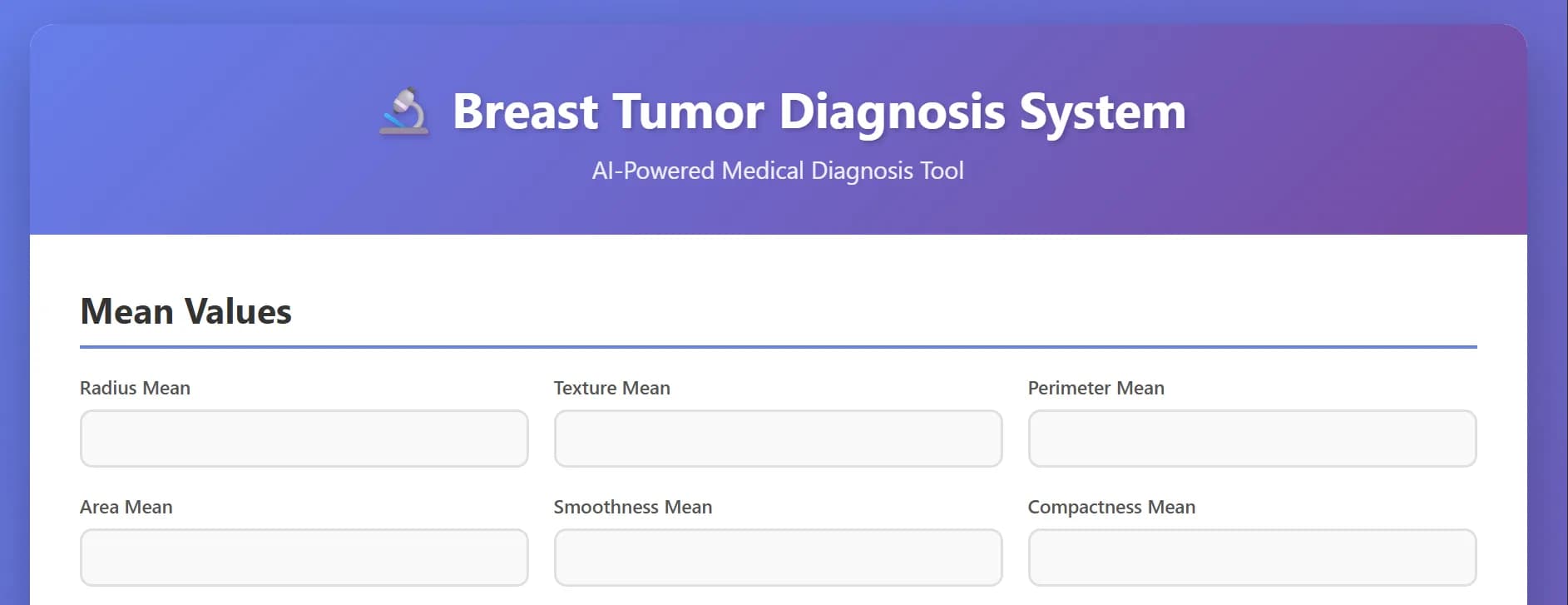
Breast Tumor Diagnosis System
A K-nearest-neighbours classifier that labels a breast tumour benign or malignant from 30 diagnostic features, served through a Flask REST API with a web interface.
Stack