Mobile
Fitness Mobile Application — Personalized Workout & Progress Tracking
A dynamic fitness mobile application that helps users follow personalized workout plans, track nutrition, monitor progress, and stay consistent with their health and fitness goals.
- Evidence
- Verified work
- Role
- full project
- Timeline
- May 2023
- Category
- Mobile
- Technologies
Overview
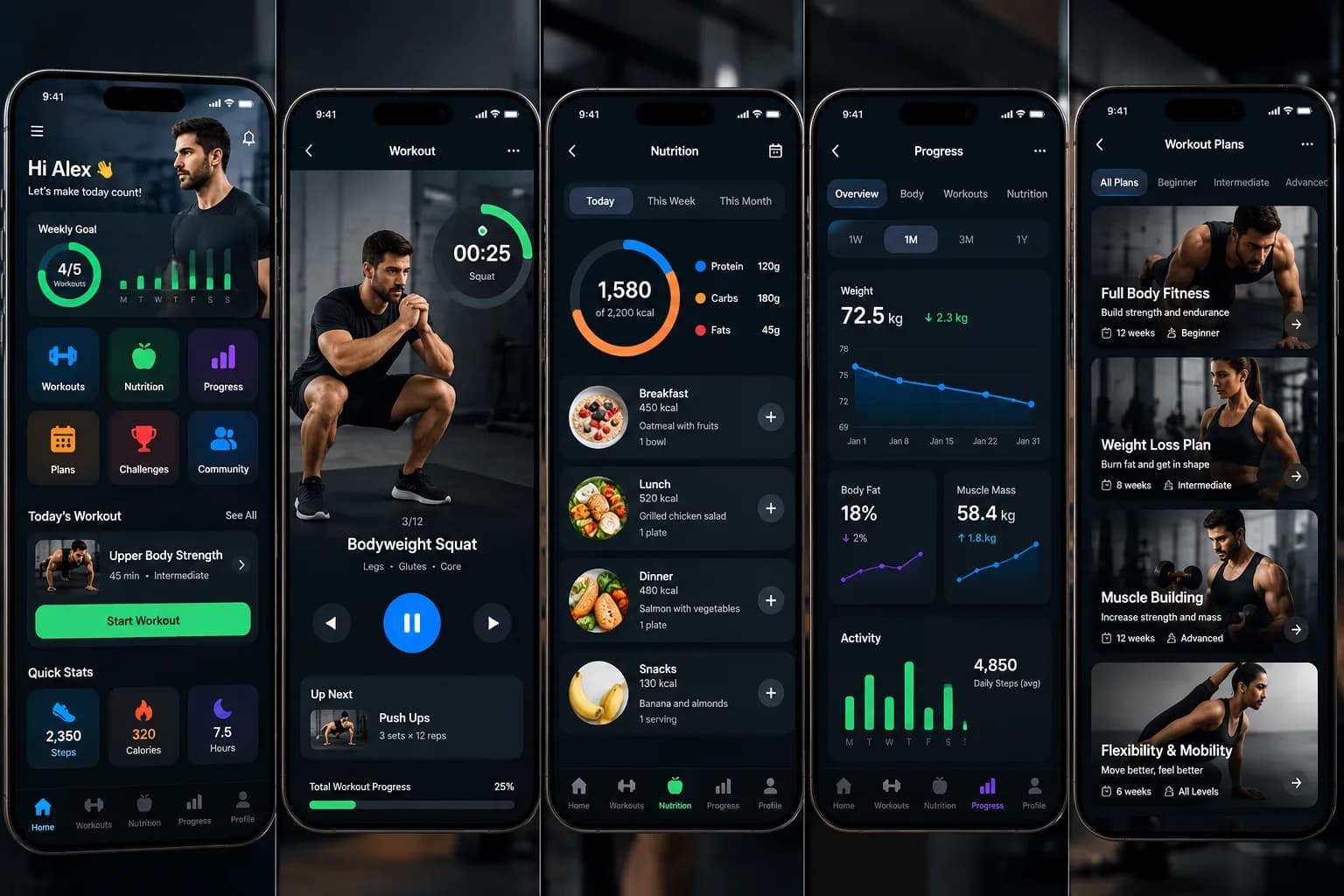
The Fitness Mobile Application is a mobile platform designed to help individuals manage their fitness journey from a single, easy-to-use application.
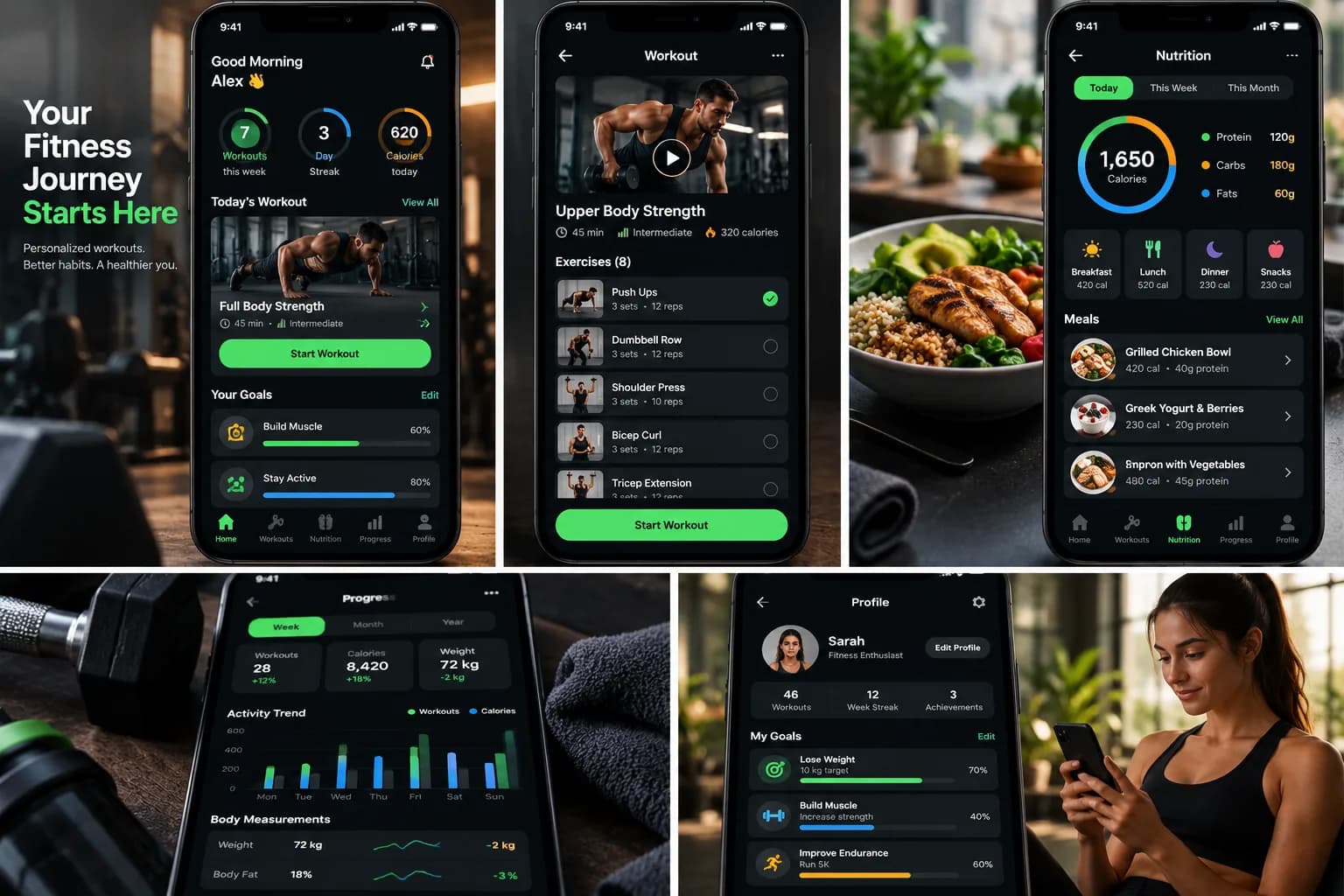
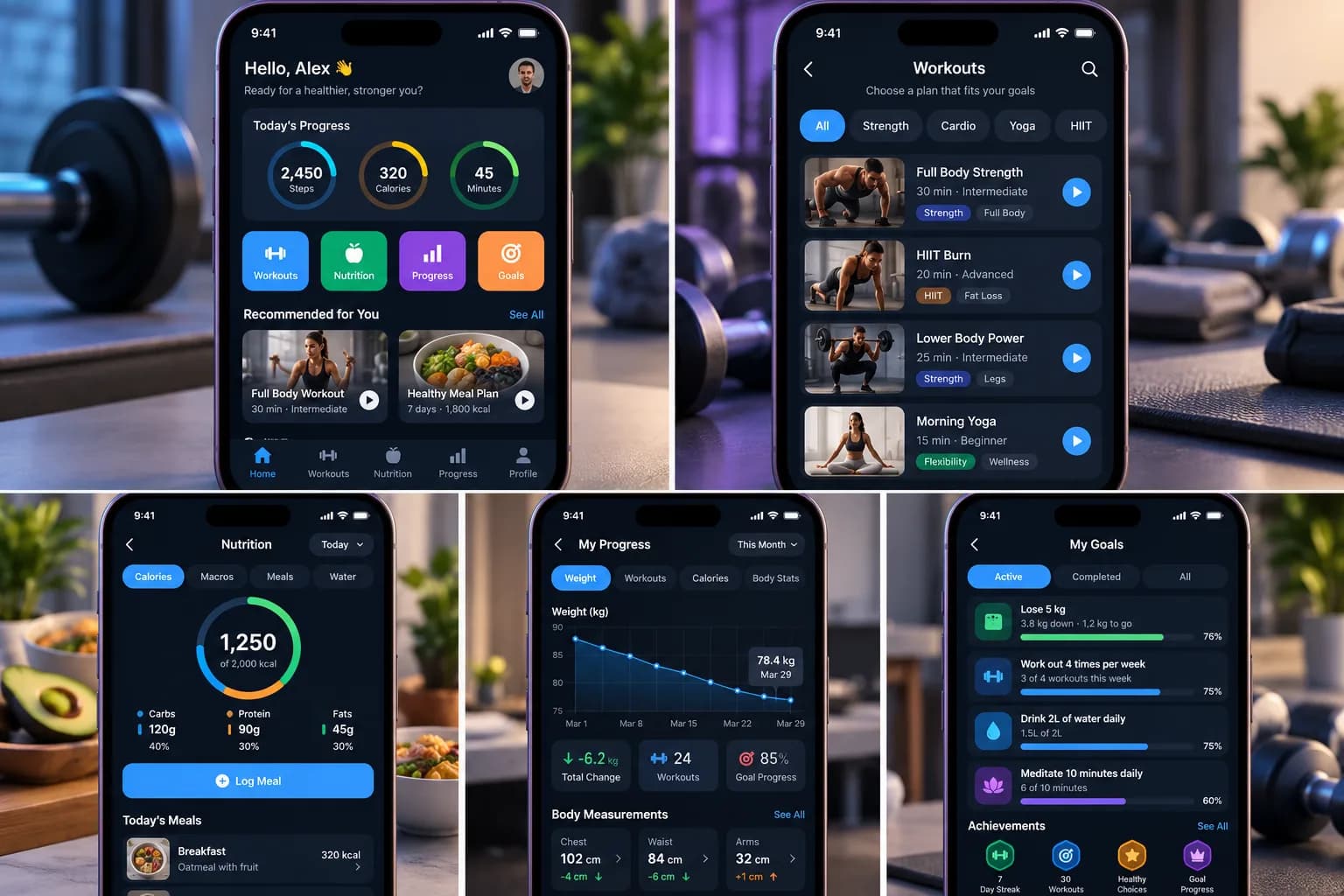
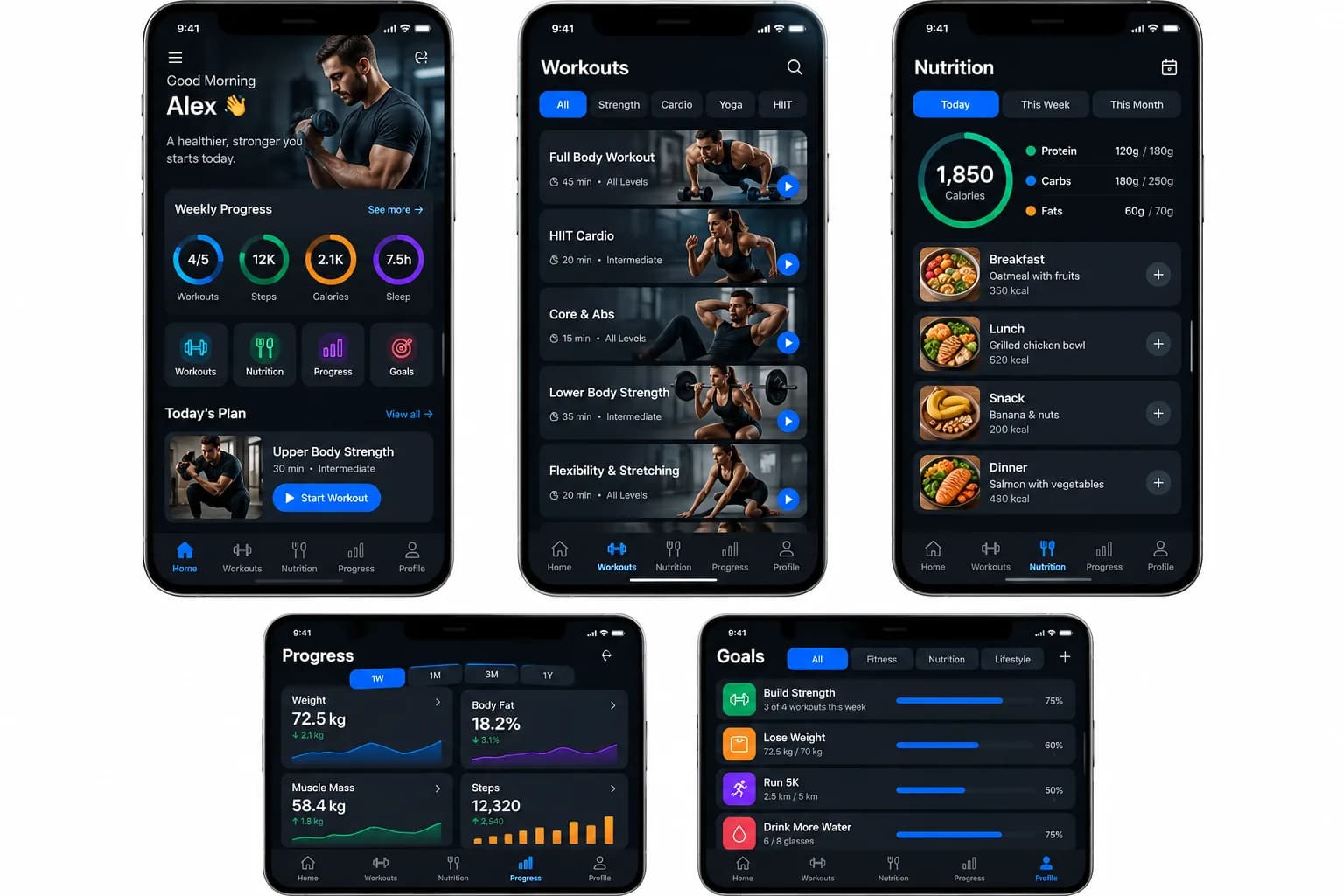
The experience combines personalized workout plans, nutrition guidance, progress tracking, fitness goals, and daily activity metrics to create a connected approach to personal fitness.
Rather than treating workouts, nutrition, and progress as separate activities, the application brings them together into one continuous fitness experience.
Problem
Maintaining a consistent fitness routine often requires managing several different aspects at the same time.
Users need to know what workout to perform, understand their nutrition, track physical progress, and stay motivated over time. When these activities are handled separately, it becomes difficult to understand whether daily actions are actually contributing toward larger goals.
The application addresses this by providing a centralized environment where users can:
- Discover workout plans
- Follow structured exercises
- Track calories and nutrition
- Monitor weight and body metrics
- Set fitness goals
- Track daily activity
- Review historical progress
- Maintain workout consistency
The goal is to turn scattered fitness activities into one measurable and structured journey.
Constraints
The application was designed as a fitness and wellness mobile platform, with the emphasis placed on the digital product experience rather than attempting to implement every capability of a clinical or professional fitness ecosystem.
Key constraints included:
- Keeping the mobile experience simple
- Supporting different fitness goals
- Presenting large amounts of fitness data clearly
- Making workout tracking quick to use
- Connecting nutrition and exercise information
- Maintaining a consistent visual experience
- Avoiding unnecessary complexity
- Creating a foundation that can support future personalization
The project focuses on fitness management and user engagement rather than medical diagnosis or clinical health management.
Approach
The application was designed around the user's complete fitness cycle:
Set Goals → Follow Plan → Track Activity → Monitor Nutrition → Measure Progress → Adjust
The main experience is organized around several connected areas:
Home → Workouts → Nutrition → Progress → Goals → Profile
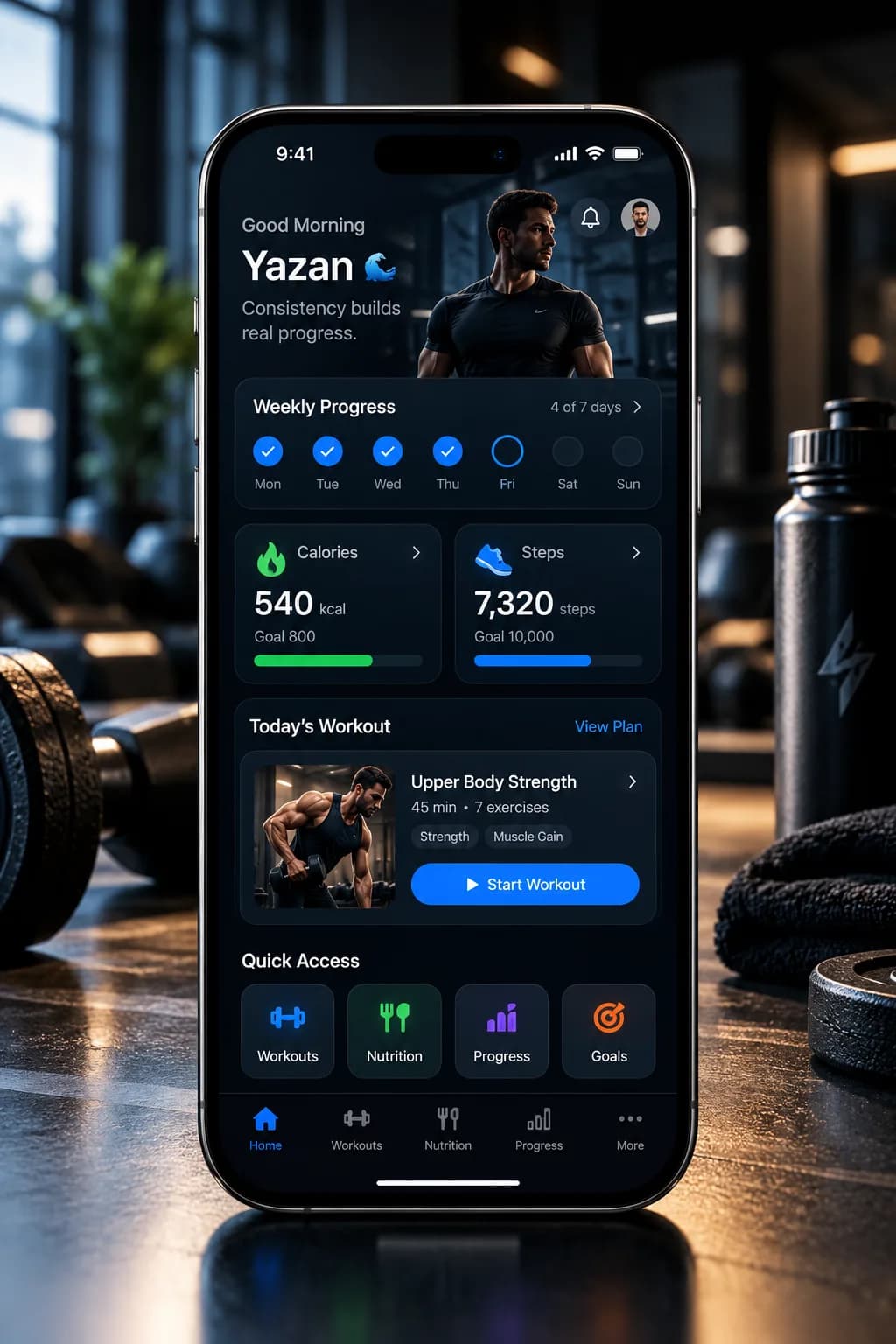
The home dashboard provides a quick overview of the user's current state, while dedicated sections allow users to go deeper into workouts, nutrition, measurements, and long-term goals.
Personalized recommendations can then connect these areas together—for example, suggesting a workout based on the user's selected plan or presenting nutrition information alongside fitness progress.
Architecture
The application can be structured around several connected modules:
Mobile Client → User Profile → Fitness Engine → Tracking Modules → Progress & Recommendations
User Profile
Stores the user's fitness preferences, goals, activity level, and relevant configuration used to personalize the experience.
Workout Management
Provides workout plans, exercise libraries, workout categories, difficulty levels, durations, and exercise tracking.
Nutrition
Manages daily calories, macronutrients, meals, hydration, and nutritional targets.
Activity Tracking
Collects activity-related metrics such as steps, calories burned, workout frequency, and other measurable activity indicators.
Progress Tracking
Aggregates historical information into charts, trends, body measurements, and progress summaries.
Goal Management
Allows users to define and monitor goals such as:
- Building strength
- Losing weight
- Increasing endurance
- Maintaining activity
- Improving consistency
Recommendation Layer
Uses the user's goals, activity, and progress information to provide relevant workout, nutrition, and goal-related recommendations.
Intelligence layer
The application's intelligence is primarily based on personalization, fitness rules, progress analysis, and recommendation logic.
Goal-Based Personalization
The system can use the user's selected objective to determine which types of workouts, metrics, and recommendations should receive greater emphasis.
Workout Recommendations
Workout suggestions can be adapted based on factors such as:
- Fitness level
- Selected goal
- Previous activity
- Workout category
- Available schedule
Progress Analysis
Historical measurements can be analyzed to identify trends in metrics such as weight, body composition, workout frequency, and activity.
Nutrition Targets
Daily nutritional information can be compared against user-defined targets to provide a clearer picture of consumption.
Consistency Tracking
Streaks, completed workouts, weekly activity, and goal progress can be combined into a broader measure of consistency.
Adaptive Recommendations
As the user's activity changes, recommendations can evolve accordingly, creating a more personalized experience over time.
The intelligence layer can later be expanded with machine-learning models, but the foundation can operate effectively through deterministic personalization and recommendation rules.
Engineering decisions
Modular Fitness Architecture
Workouts, nutrition, progress, and goals are treated as separate modules while remaining connected through the user's profile and fitness journey.
Goal-Centered Data Model
Goals are treated as a central concept rather than simply another profile field. This allows workouts, nutrition, and progress to be evaluated in relation to the user's objectives.
Progress as Historical Data
Fitness measurements are more useful when viewed over time. The system therefore benefits from storing historical records rather than only the user's current state.
Reusable Workout Components
Exercises and workout plans can be represented as reusable entities, allowing them to appear across different plans and recommendations.
Dashboard-First Experience
The home screen prioritizes the information users need most frequently: today's activity, current progress, recommended workouts, and key metrics.
Visual Data Representation
Charts, progress rings, achievement indicators, and trend cards make numerical fitness information easier to interpret.
Mobile-First UX
The interface prioritizes touch interaction and fast access because many actions take place immediately before, during, or after physical activity.
Extensible Personalization Layer
The architecture can later support more sophisticated recommendation systems, wearable integrations, adaptive plans, and machine-learning models.
Challenges
1. Personalizing the Fitness Experience
Different users have different goals, fitness levels, schedules, and nutritional requirements. Designing a system that can accommodate these differences without making the application complicated was a key challenge.
2. Connecting Workouts and Goals
A workout should not exist in isolation. It should contribute to a larger goal such as improving strength, losing weight, increasing endurance, or maintaining activity.
3. Tracking Progress Over Time
Fitness progress is inherently longitudinal. The application needs to represent changes in weight, workouts, calories, measurements, and other metrics in a way that makes trends understandable.
4. Nutrition Tracking
Nutrition involves multiple dimensions including calories, macronutrients, meals, hydration, and daily targets. Presenting this information clearly on a mobile screen requires careful information hierarchy.
5. Maintaining User Motivation
Fitness applications are heavily dependent on consistency. Progress indicators, streaks, achievements, goals, and daily recommendations need to provide useful feedback without overwhelming the user.
6. Designing for Different Workout Types
Strength training, cardio, HIIT, yoga, mobility, and other activities require different information and interaction patterns while still needing to feel like part of one application.
7. Mobile-First Interaction
Workout and fitness tracking often happens while the user is physically active. Controls therefore need to be easy to understand and interact with quickly.
Results
The project establishes a connected fitness mobile experience that brings workouts, nutrition, goals, activity, and progress tracking into one platform.
The application provides a foundation for:
- Personalized workout plans
- Exercise tracking
- Nutrition monitoring
- Calorie and macro tracking
- Fitness goals
- Progress analytics
- Activity monitoring
- Consistency tracking
- Personalized recommendations
The result is a fitness platform designed around the complete user journey rather than a collection of disconnected tracking tools.
The foundation can be extended with wearable-device integrations, smartwatch support, AI-powered workout recommendations, adaptive training plans, social challenges, coach features, meal planning, and more advanced analytics.
Media
Related projects
Software engineering
Tavola — Multi-Tenant Restaurant Reservation Platform
A multi-tenant SaaS for restaurant reservations, tables, branches and staff: NestJS backend with real-time updates, a Flutter customer app, a React restaurant dashboard and a platform-owner console.
Stack
Mobile
Mobile
Taxi Elite Application — Taxi Booking & Car Rental Mobile App
A mobile taxi booking and car rental application designed to simplify ride booking, vehicle selection, real-time trip tracking, payments, and rental management.
Stack